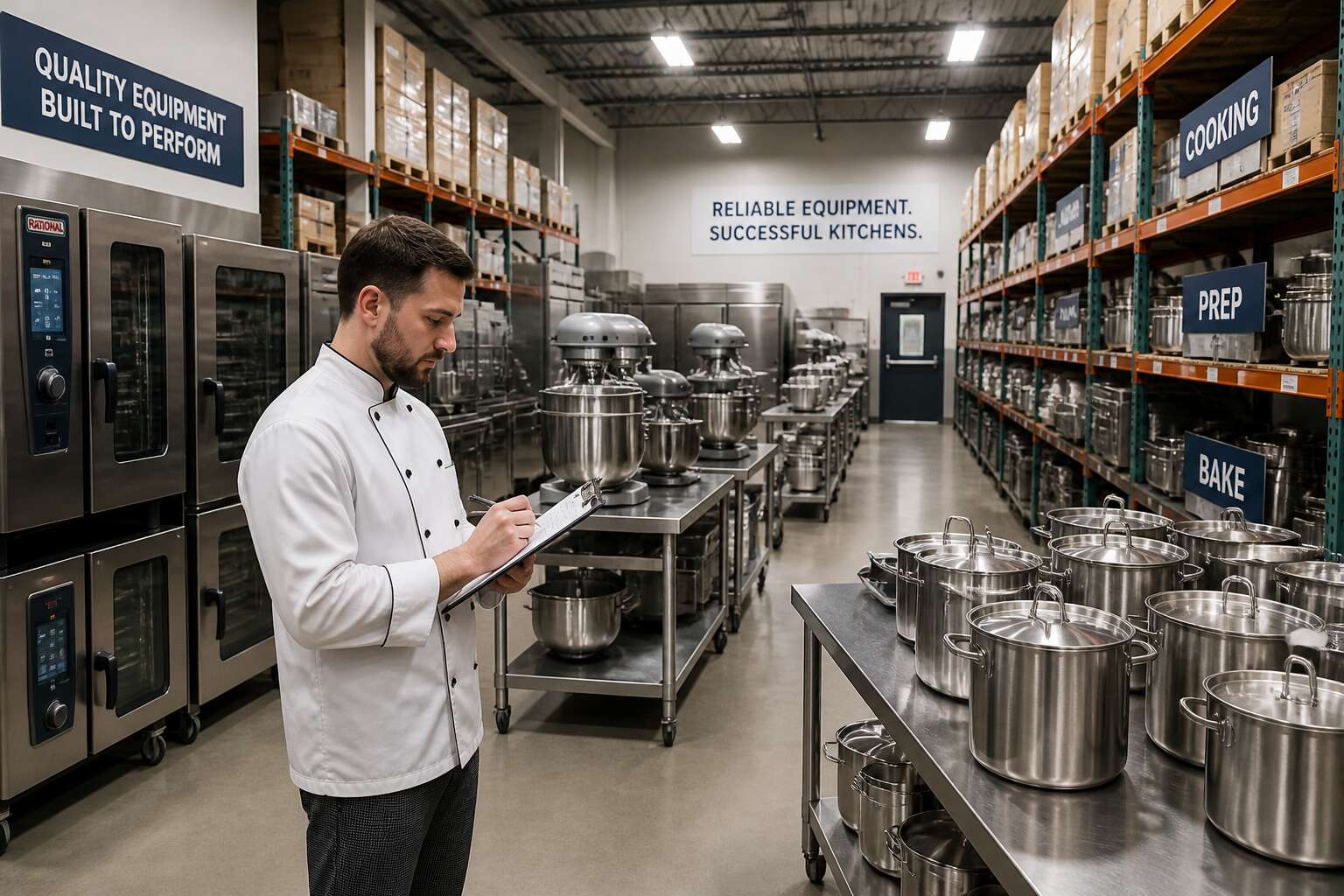
Understanding the Wholesale Advantage for Caterers
Cost Efficiency and Margin Improvement
In South Africa, catering margins often hover below 15%. That figure forces hard choices. One of the smartest choices is sourcing catering equipment wholesale. Buying direct from importers or local distributors removes the middle layer. Your cost per unit drops. Your margin improves. Simple arithmetic. We’ve watched Johannesburg caterers shave 18% off their fit-out costs this way!
Wholesale contracts also change payment terms. Many suppliers stagger payments across months. That preserves cash flow for perishables and labour. The result is a healthier balance sheet.
Consider what wholesale actually changes:
- Bulk pricing on stainless steel tables and ovens
- Commercial-grade ranges without retail markup
- Consolidated freight on a single delivery
These savings compound across a full kitchen fit-out.
Access to Professional-Grade Equipment
Most catering businesses in Durban run on stoves meant for family homes. That is not a choice. It is a constraint. Catering equipment wholesale changes that. Wholesale suppliers carry professional ranges, blast chillers, and stainless steel prep tables that retail stores never stock. These tools handle continuous use and harsh cleaning cycles. They also meet safety standards that home appliances simply lack.
When you buy through catering equipment wholesale, you access the same brands used by hotel kitchens and industrial caterers. That means equipment built for speed and volume. Consider what becomes possible!
- Ovens with even heat distribution across multiple trays
- Refrigeration units that hold temperature during load changes
- Heavy duty mixers that knead dough without stalling
Each piece is tested for commercial shifts, not occasional dinners. That is the wholesale advantage for caterers who want to cook at scale without constant breakdowns.
Streamlining Inventory and Supply Chain
Every hour spent chasing a replacement part is an hour not spent preparing food. For caterers in Durban, this is the quiet agony of fragmented supply chains. Catering equipment wholesale consolidates that chaos into a single point of contact.
Suppliers hold deep stock of filters, gaskets, burners, and thermostats. When a unit fails mid-week, you are not waiting on a courier from Johannesburg. The part is already on a shelf in your supplier’s warehouse.
Consider the effect on your inventory:
– You no longer warehouse spare motors or heating elements.
– Your capital stays liquid, instead of sitting in a storeroom.
– Order cycles shorten because suppliers forecast demand across hundreds of clients.
One reliable wholesale partner removes the logistics guesswork from your operation.
How to Evaluate Wholesale Suppliers
Reputation and Industry Experience
A supplier’s reputation in catering equipment wholesale lives in the quiet consistency of their delivery, not the volume of their advertising. A Johannesburg caterer once told me that the best wholesalers answer their phones on a Friday afternoon. That observation is worth more than any glossy catalogue.
Consider their tenure. A decade in the industry often signals stable supply chains and established relationships. Ask how long their warehouse staff have stayed with the company. Staff turnover reveals more than any testimonial.
Demand references from businesses of your size. A five-star hotel’s endorsement means little if you run a mobile catering operation. Inspect their after-sales behaviour as well. A supplier who returns your call about a faulty oven is a supplier who will return your money.
- Check their trade association membership and dispute history.
- Visit their physical premises if possible.
- Ask for client names in your province.
Reputation forms through small, unglamorous moments. Evaluate those carefully.
Product Range and Availability
A supplier’s product range reveals their true relationship with the industry. When you walk through a warehouse and see twenty variations of the same stainless steel chafing dish, you understand their commitment to depth over spectacle. The catering equipment wholesale market rewards those who study what caterers actually use, not what looks impressive in a showroom.
Availability becomes a psychological test. Watch how a supplier responds when you ask about stock levels for a common item. Do they check their system with confidence? Do they offer alternatives without hesitation? These small signals expose the gap between their marketing promises and their operational reality.
A genuinely comprehensive range signals a supplier who understands the rhythm of South African hospitality, from township shisanyama operations to coastal seafood restaurants. Their warehouse shelves tell a story of demand patterns, seasonal shifts, and practical knowledge. The very best suppliers maintain steady stock of the mundane items, the mixing bowls and serving tongs that keep kitchens running. They judge their success by your ability to prepare dinner service, not by their catalogue thickness. When you find a supplier whose range mirrors your actual needs, you have found a partner who sees your operation clearly.
What does their backroom look like when they are busy? What does their delivery schedule reveal about their reliability? A pallet jack moving at 4 pm on a Friday speaks volumes.
Pricing Structures and Discounts
Pricing in the catering equipment wholesale sector is rarely transparent. The listed price, quoted price, and final price after rebates and tiered discounts can be three different numbers. I have seen operators celebrate a 20% discount on a combi oven, only to discover their consumables supplier funded that margin elsewhere.
A supplier offering volume discounts on fast-moving lines like foil containers may remain rigid on capital items. Some wholesalers in Johannesburg run a dual pricing model, one rate for registered businesses with tax clearance, another for cash customers. This split is common in catering equipment wholesale, so ask about rebate structures and settlement terms!
- Does the discount apply retroactively to your entire order or only to final units?
- Are there minimum order thresholds that reset monthly or quarterly?
- What happens to the discount if you return a damaged item?
Request a full price list in writing. Genuine operators will produce it without hesitation, because their pricing survives scrutiny.
Delivery and Logistics Support
Delivery timelines often reveal the reliability of a catering equipment wholesale partner. The glossy catalogue promises nothing if the truck arrives three weeks late. In South Africa, where distances between cities like Johannesburg, Durban and Cape Town are significant, the supplier’s logistics network becomes part of your own operational chain.
Consider how the supplier manages stock availability. A wholesaler holding regional warehousing can dispatch within 48 hours. One that relies on backorders will test your patience and your storage capacity.
Ask about transport conditions for sensitive equipment. Refrigeration units need careful handling. Dedicated delivery vehicles and trained crew protect your investment before it reaches your kitchen.
- Do they offer scheduled delivery slots?
- Are there additional charges for after-hours drops?
- What is their policy for delivery damage claims?
The answers will reveal whether this catering equipment wholesale relationship supports your daily workflow or complicates it.
Critical Equipment Categories for Catering Businesses
Commercial Cooking Appliances
The commercial kitchen is a theatre of fire and steam. In South Africa, where load shedding tests every operator’s nerve, your commercial cooking appliances must endure relentless abuse.
A standard arsenal includes:
– Heavy duty gas ranges with multiple burners
– Convection ovens for consistent baking
– Plancha grills for high volume service
– Deep fat fryers with rapid recovery
Every unit must survive hours of continuous operation. Sourcing from a reliable catering equipment wholesale partner gives you access to industrial grade machinery built for this punishment. The alternative is downtime, and downtime devours profit. Your pass line depends on equipment that never falters.
Refrigeration and Storage Solutions
Thirty percent of South African food service inventory is lost before it ever touches a plate. The silent culprit is not poor sourcing or lazy staff, it is inadequate cold storage. While the range and the grill command attention, the walk-in freezer works in obscurity, preserving your margins through every load-shedding cycle.
Refrigeration is the financial conscience of an operation. A single degree of fluctuation can compromise an entire crate of fresh produce. The right storage units provide more than mere cold air. They offer a stable environment where proteins rest safely and dairy holds its integrity. Consider the critical infrastructure:
– Reach-in refrigerators for high turnover prep areas
– Blast chillers that safely cool hot food to holding temperature
– Under-counter units for maximising limited floor space
– Multi-door freezers for bulk dry goods and frozen proteins
The heart of a profitable kitchen is not the stove. It is the cold room where waste is managed and freshness is guarded. A trusted catering equipment wholesale partner understands this dynamic and supplies units engineered for the local climate. Their equipment must handle the dust, the heat, and the unpredictable power supply. Walk their floor and you will see the difference between consumer fridges and commercial fortresses. Airflow systems, compressor quality, and insulation thickness all tell a story of survival. Choose the quiet reliability of proper cold storage, and your kitchen will hum with efficiency instead of humming with anxiety.
Food Preparation and Handling Tools
The knife slips. A momentary lapse in concentration, and the prep cook’s hand is at the blade. That is the reality of a kitchen running on tired bones and cheap equipment. A professional catering equipment wholesale supplier changes that equation entirely. They provide tools engineered for the long shift, tools that respond predictably when fatigue sets in.
The mechanical workhorses deserve scrutiny. Consider the humble meat slicer. A unit from a reliable catering equipment wholesale partner holds its adjustment through a full service. The carriage moves without binding. The blade guard engages with a solid click. These details are not trivial refinements. They are the difference between a clean portion and a mangled one, between confidence and hesitation.
Preparation tools are a psychological contract with the person holding them. When the scale reads true after months of hard use, trust builds. When the chafing dish holds temperature without a fuss, the floor manager stops worrying about the buffet. That quiet reliability creates space for the mind to focus on flavour, presentation, and timing.
– Commercial grade food processors with overload protection
– Heavy duty mixing bowls that stay put on wet counters
– Thermapen style instant read thermometers for spot checks
– Colour coded cutting boards that survive the dishwasher, not just the first week
A knife block from a wholesale supplier is another statement. The steel holds an edge beyond the first rush. The handle fits the palm after hours of repetitive motion, not just the initial grip. It is the quiet, unglamorous gear that keeps the pass moving while the world outside argues about menu trends.
Serving and Display Equipment
Picture a busy Sunday buffet at a Joburg hotel. The bain-marie runs dry, the sneeze guard rattles, and the chafing dish flame sputters. That scene is a liability. Serving and display equipment from a catering equipment wholesale partner works differently. These units maintain consistent heat, resist tipping, and survive constant opening and closing.
Consider the display counter. A poor one fogs up, drips condensation, and turns a beautiful spread into a sad, wet mess. A proper unit uses airflow design and tempered glass. It shows off the food without making it sweat.
- Chafing dishes with adjustable fuel holders
- Bain-marie inserts that fit standard pan sizes
- Heated display shelves with independent controls
- Sneeze guards with sturdy hinges
Service backup matters when the buffet opens in an hour and the thermostat fails. A wholesale supplier who stocks spare parts keeps that equipment running.
Bulk Buying Tactics to Maximize Your Investment
Volume Discounts and Negotiation Tips
When you negotiate a catering equipment wholesale agreement in South Africa, the conversation usually starts with price per unit, but that metric alone is an illusion. The true cost calculation involves delivery windows, warranty terms, and the opportunity cost of a broken oven during a weekend function. Your purchasing power only becomes leverage when you commit to a single supplier for multiple categories, and that commitment deserves a tiered pricing model.
– 10 to 20 units often unlocks a 3% to 5% discount
– 20 to 50 units frequently triggers free freight to Johannesburg, Durban, or Cape Town
– 50 or more units can shift the conversation toward extended payment terms of 60 or 90 days
My experience shows that suppliers prefer predictable turnover over high margins. When you propose a quarterly purchase volume rather than a one-off order, the vendor can plan their own stock levels and import schedules, which gives them room to shave margins. This is where volume discounts become a psychological game. You are not asking for a favor. You are offering financial predictability.
The negotiation itself requires a subtle shift in perspective. Do not lead with your lowest target price, because you will remove your own room for trade-offs. Instead, anchor the discussion around the total annual spend and then ask what value the supplier can add to justify that figure. This approach prompts the vendor to offer service extras, like priority technical support or spare parts holding, which often hold more operational value than a flat rand amount. The final price should be a consequence of the relationship, not the starting point of the argument. The best deals in catering equipment wholesale emerge when the buyer demonstrates a long term vision and the seller feels secure in their revenue stream.
Seasonal Purchasing and Trend Forecasting
Bulk buying in catering equipment wholesale rewards those who read the calendar. South African demand spikes around December weddings and winter gastronomy festivals. Smart buyers purchase low season, when suppliers hold excess stock and negotiate from a position of eagerness. A blast chiller acquired in May might cost 14% less than the same unit in October.
Trend forecasting sharpens this approach. Electric grills and waterless cooking systems are rising. Committing to these lines early, through a single bulk order, secures pricing before demand inflates.
- Analyse municipal energy policy shifts; they create sudden equipment needs.
- Source containerised stock arrivals; prices drop just after customs clearance.
Seasonal buying is a strategic calculation. When you align procurement with the ebb of local demand, your catering equipment wholesale investment outpaces the market’s average.
Managing Storage and Inventory Turnover
Bulk buying rewards the buyer who respects the warehouse. Every rand tied up in stock is a rand not working elsewhere. The catering equipment wholesale buyer must calculate storage costs before signing a volume order. I have watched operators pay twice for the same equipment: once at purchase, again in storage fees.
Inventory turnover dictates the rhythm of reinvestment. Slow movers drain capital; fast movers justify their space. The experienced operator rotates stock with precision, ensuring each unit earns its square meter.
- Storage cost per cubic meter shapes the real price of volume
- Monthly turnover rates reveal which categories deserve more space
- Supplier buy-back clauses protect against slow-moving stock
This discipline turns a bulk purchase into a working asset.
Comparing Wholesale vs. Retail Lifelong Value
In South Africa, a single retail purchase of a catering equipment wholesale unit often carries a 40% markup that the buyer never recovers. Wholesale pricing changes the arithmetic. The gap is not only the initial discount; it is the compounded value of every rand saved going back into the operation.
Consider the lifespan of a commercial-grade machine. Retail equipment for home use may burn out in three years. A wholesale-grade unit from the commercial supply chain can run for a decade or more. I have watched both fail and thrive. The price per year of service reveals the difference.
The real advantage sits in the secondary market. Professional units hold resale value. Retail units turn into scrap. Catering equipment wholesale buyers purchase assets with residual worth. Compare that to the retail buyer who owns nothing but a depreciated shell. That is the lifelong value equation.
Ensuring Quality and Safety Standards in Bulk Orders
Certification and Compliance Checks
One defective pot in a hundred might seem trivial, but it can cost you a health inspection failure. When procuring catering equipment wholesale, certification separates reliable suppliers from hopeful amateurs. I always demand SABS approval and ISO compliance before any order ships. This is not bureaucratic exercise; it is practical protection.
A thorough compliance check covers several elements:
– Certification documents for each product line
– Test reports from accredited laboratories
– Traceability records for raw materials
Suppliers who hesitate to provide these are hiding something. Local bylaws in South Africa vary, so confirm that your equipment meets municipal standards. A compliant bulk order protects your team and your customers. It also prevents expensive surprises after delivery.
Warranty and After-Sales Support
Bulk orders present a peculiar social contract. You are not buying one oven, you are buying fifty ovens that must behave identically. I have learned to ask specifically how the supplier handles batch variations. A reputable catering equipment wholesale partner will perform random sampling on your order before dispatch, not after.
Warranty terms deserve the same scrutiny as the price tag. Some suppliers vanish once the invoice clears. I insist on written after-sales commitments, including response times and spare parts availability.
When evaluating warranty support, consider:
- The length of the parts and labour warranty
- Whether a local technician is available
- The process for lodging a claim
These details separate a transaction from a partnership.
Inspection and Quality Assurance Processes
Every batch of equipment carries small variations. In a single oven, that variation is a nuisance. Across fifty ovens, it becomes a service nightmare. That is why inspection protocols matter more than the invoice value. When I negotiate with a catering equipment wholesale partner, I ask where the quality checks happen. On their floor or on my loading dock? The answer changes everything.
A proper process includes random sampling before dispatch, line checks during assembly, and documentation of any deviations. I have seen suppliers reject an entire run for a faulty gasket, and I have seen others ship it and hope. The second type costs you customers. The first type might cost you a delay, but it protects your reputation.




0 Comments