The Role of Packaging in Event Dining
How Containers Affect Temperature and Freshness
Packaging silently scripts the entire dining experience. A lamb biryani in a flimsy container arrives with basmati grains glued into a sad, steaming clump. Yet robust catering boxes with thermal liners hold the dish at serving temperature for an hour, preserving saffron threads and crisp onion. I have watched this difference ruin or rescue events.
Moisture control is critical. Without controlled condensation, steam redeposits on delicate surfaces. Ventilated compartments solve this, keeping grilled chicken separate from roasted vegetables. The container’s geometry matters. Shallow trays expose more surface area, cooling faster, while deep catering boxes retain heat but risk sogginess. Organisers, three factors deserve scrutiny!
- Aluminium trays conduct heat but lose warmth quickly.
- Insulated plastic boxes maintain temperature longer.
- Paperboard with polymer coating balances breathability and seal.
Freshness is a matter of seconds. The interval between kitchen and table is where good packaging earns its keep.
Addressing Portion Control and Dietary Needs
Plating precision begins long before the table. Catering boxes with fixed compartments do the work of a portion control chef, reducing waste and keeping servings consistent. In South Africa, where events range from intimate braais to large corporate banquets, this matters deeply. A guest with a gluten intolerance should not have to pick around a shared platter.
Modern packaging now includes printed labels or colour coded lids, allowing servers to identify dietary needs at a glance. Some designs feature adjustable dividers for varying appetites.
- Vegetarian meals in green sealed compartments
- Halal options in blue trays
- Nut free dishes in red containers
These small signals prevent cross contact and confusion. For event organisers, catering boxes become a communication tool, not merely a carrier.
Key Factors in Choosing Food Service Containers
Material Options: Cardboard, Plastic, and Aluminum
Every catered meal begins with a decision that guests never see. The material of the box determines how the food travels, how it presents, and what remains after the plates are cleared. In South Africa, where municipal recycling systems vary widely, this choice carries consequences.
In my experience, cardboard feels honest and renewable, yet it struggles with saucy dishes. Plastic offers resilience and a clear view of the food, but its provenance and disposal demand scrutiny. Aluminum brings thermal strength and infinite recyclability, though it creases and costs more.
Weigh these factors:
- Moisture resistance and structural integrity
- Recyclability within your local waste stream
- Cost per unit against your menu pricing
- Perceived quality by your clients
I have found that the best catering boxes emerge from this tension, matching material to purpose without pretending one option fits every occasion.
Thermal Insulation: Keeping Meals Hot or Cold
A lukewarm bobotie is a common complaint at South African weddings. The distance between a commercial kitchen and a bushveld venue often exceeds ninety minutes, and load shedding can stall the service line. Thermal insulation in catering boxes is not a luxury; it is the difference between a meal that arrives ready to serve and one that arrives as a disappointment.
The science is straightforward. Heat transfers through conduction, convection, and radiation. A good box slows all three. The air gap inside the walls acts as a buffer. The reflective foil lining bounces radiant heat back to the food. A tight seal prevents convection currents from leaking out the edges. I have seen boxes that look identical on the outside perform vastly differently, simply because one has a thicker core.
When evaluating thermal performance, I check three things:
- The thickness of the insulated core, measured in millimeters, not marketing claims.
- Whether the lid has a gasket or a simple flap that lets heat escape.
- How the box handles condensation, because moisture steals heat rapidly.
In practice, a standard cardboard box with a foil lining might hold heat for thirty minutes. A dedicated insulated container, often with a plastic shell and foam core, can hold it for two hours. Choosing catering boxes for thermal performance means accepting a higher unit cost, but it saves you from reheating, which ruins texture and taste. For a Cape Town winter function, that thermal margin is everything.
Leak Resistance and Structural Durability
The worst sound in catering is the drip of a failing box! A leaking curry stains the vehicle, ruins the invoice, and ends a client relationship. Structural durability matters just as much. A box that collapses under a second tier of trays spills everything.
I check three things on every catering box:
- The seal around the lid, not the thickness of the plastic.
- The corner welds, where most failures start.
- The base rigidity, because flexing means cracking under load.
A pinch of caution here. Heavy chafing dishes need a box rated for vertical stacking. The older your fleet, the rougher the roads in Gauteng. Catering boxes with welded corners and gasketed lids survive the trip to the table.
Eco-Friendly Alternatives and Biodegradable Materials
Biodegradable options have moved past the trade off stage. Bagasse, the fibrous pulp left after sugarcane processing, resists soaking and stays rigid. Moulded bamboo fibre offers similar strength. Even recycled cardboard now comes with compostable linings. The term biodegradable means little without a certified standard.
The challenge is the sauce. Acidic and oily contents break down many plant based films. I look for PFAS free coatings that withstand both heat and grease. Among catering boxes, the eco range tends to cost more per unit. That price gap shrinks when you factor in waste disposal fees and client goodwill. Durban and Cape Town have different recycling streams, so the choice of material depends on your delivery radius.
Stackability and Space-Saving Design
Stackability decides whether your delivery driver returns on time. In busy metros like Johannesburg, every cubic centimetre of the van matters. A catering box with tapered walls nests neatly, while square shoulders waste space. The same principle applies in the cold room and the dry store.
Here is what I check before ordering catering boxes in bulk:
- Lid strength: flimsy lids collapse under a second tier.
- Corner geometry: rounded corners reduce empty space.
- Base rim design: a locking rim prevents sliding.
The storage room matters too. Catering boxes that stack evenly on a shelf cut down the time staff spend reorganising. That saving passes directly to your margins.
Customization and Branding Opportunities
Printing Logos and Custom Artwork
Consider the moment a client lifts the lid. Your catering boxes carry your name into rooms where word of mouth becomes contract. In South Africa, where events hinge on first impressions, printed logos and custom artwork turn a container into a statement.
I have seen businesses invest heavily in food, then hand it over in plain packaging. That is a missed opportunity. A well designed box reinforces your identity. Print full color logos, add patterns that echo your brand palette, or commission original illustrations for your specific audience.
- Logo placement on lid and side seams
- Custom artwork for seasonal menus
- Taglines near the closure flap
Each design choice costs little compared to the reputation it protects. Suppliers provide templates and proofing sessions, so you approve every mark before production. Your catering boxes then work as hard as your staff.
Choosing Colors That Reflect Your Brand Identity
Color speaks before the lid is lifted. In South Africa, bright sunlight can drain a weak palette entirely, leaving your catering boxes invisible on a venue table. I have watched this happen at events where the food deserved better representation.
Catering boxes painted in your brand colors do the marketing work before a single bite is taken. Choose shades that survive the journey from kitchen to venue. Deep blacks hide the smudges of transport. Rich earth tones echo the Karoo. Bold jewel tones stand out in crowded function rooms.
- Warm reds and oranges signal spice and fire
- Cool greens and blues promise freshness
- Neutral kraft tones suggest rustic, honest ingredients
Test your colors under the actual lighting where clients will eat. A shade that looks striking on screen can turn muddy under fluorescent bulbs or ghostly in candlelight. The right color makes your catering boxes unmistakable from across the room!
Custom Compartments and Dividers for Meal Variety
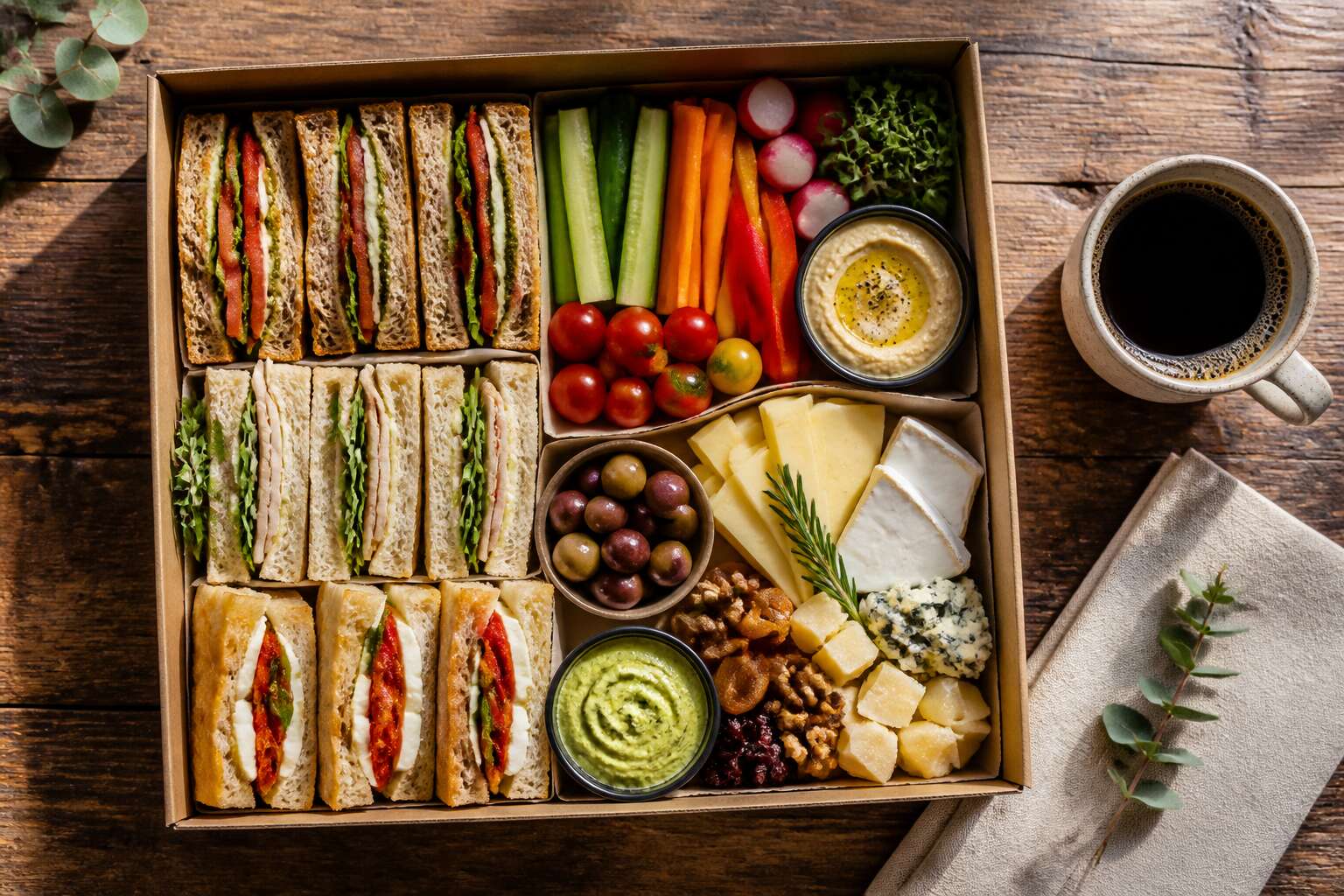
Catering boxes gain meaning through their internal structure. The separation of stew from salad, or rice from braai meat, changes how a meal is experienced. Custom dividers let you design for contrast, for the crispness of crudités next to the warmth of roasted vegetables. This is where meal variety becomes tangible. Think beyond the standard three-cell tray. Consider deep wells for soups and shallow channels for garnishes. The arrangement itself can embody your brand’s ethos, whether that is order, abundance, or surprise.
- Preserve structural integrity of each dish
- Allow portion control without visual monotony
- Turn unboxing into a deliberate ritual
The geometry of your catering boxes communicates care. When a client peels back the lid, the compartments reveal a curated sequence, not a jumble. That is branding without a single printed word.
Adding Labels, Stickers, and Branded Inserts
Labels, stickers, and branded inserts give your catering boxes a voice beyond the meal. A sticker on the lid communicates handling instructions. A branded insert tells the story of the dish. These elements work together to create a tactile experience.
Consider the unboxing moment. The client lifts the lid and finds a wax seal, a handwritten note, or a menu card. That sequence builds anticipation. It also serves practical functions. For example:
- Stickers can indicate allergens and serving temperature.
- Inserts can include the chef’s name or a QR code for feedback.
The branding feels personal, and the client remembers that care.
Themed Packaging for Holidays and Corporate Events
Holidays and corporate events demand catering boxes that feel intentional, not generic. A Christmas lunch for a Johannesburg firm carries different energy than a year end function in Cape Town. I love how themed packaging lets you align the unboxing with the occasion!
For festive seasons, add gold foil accents or a subtle winter motif. For corporate milestones, think about the client’s industry. A tech launch might use clean geometric patterns, while a heritage brand could favour muted earth tones.
- Festive menus with seasonal colour palettes
- Event specific messaging on the lid
- Custom dividers that hold themed treats
These choices do more than decorate. They show you understood the brief. That attention turns a simple order into a talking point, and your catering boxes become part of the event’s memory!
Cost-Effective Approaches for Bulk Orders
Maximizing Savings Through Volume Purchasing
The difference between ordering a hundred catering boxes and a thousand is often more than 20 percent. Volume purchasing delivers the same logic: the more you order, the less each box costs. Many businesses overlook the straightforward arithmetic of bulk discounts. Consolidating your quarterly needs into one purchase often triggers price breaks that are unavailable to small orders.
- Compare freight costs, as shipping can erase savings if delivery distances vary.
- Verify the supplier’s minimum order thresholds and their corresponding price tiers.
- Factor in storage expenses, since pallets of boxes take up valuable space.
When your menu remains consistent, committing to a standard set of catering boxes becomes straightforward. The cumulative effect on your bottom line is substantial, turning packaging into a source of efficiency rather than a passive expense.
Balancing Affordability with Quality Standards
A single structural failure can ruin a tray of prepared meals, turning a low-cost box into an expensive mistake. Balancing affordability with quality demands that you inspect sample batches carefully. Test those catering boxes under realistic conditions, including stacking in a chiller and a bumpy delivery route.
Set clear specifications for material strength and food safety compliance. Then verify each delivery against those standards before accepting the order.
- Certificates from accredited laboratories confirm food safety.
- Consistent dimensions across units reduce fitting errors.
- Supplier feedback from other caterers reveals real-world performance.
Standardised specifications and routine inspections keep your costs predictable without sacrificing performance.
Timing Purchases to Take Advantage of Discounts
The quietest months often hide the best prices for catering boxes. Suppliers reduce stock before demand peaks, and timing your purchase around these cycles can slash what you pay per unit. I have seen the price drop by nearly fifteen percent simply by ordering three weeks after a major holiday.
Watch for discount windows tied to raw material costs or shipping lulls. A quick call to your supplier can reveal upcoming promotions!
- Order at month end when sales targets force flexibility
- Book during off season, not just for volume but for lower per unit rates
- Request quotes before and after price adjustment dates
Such timing tactics keep your budget predictable without sacrificing the standard you need.
Minimizing Waste to Reduce Overall Expenses
Across South Africa, the true cost of a catering order is not only the price on the invoice. It is the silent expense of wasted food, lost to overfilled portions and flimsy containers. Smart operators know that every rand saved on waste is a rand added to profit, and the right catering boxes are the frontline defense.
I have seen events where a robust, correctly sized box reduced leftover food by a third. When you order in bulk, the design of your packaging becomes a financial lever. Selecting a sturdy, leak resistant unit prevents spoilage during transit, while precise compartmentalization encourages portion control.
To effectively minimize waste, consider the following strategies:
– Choose boxes that match your exact menu portions to avoid overpacking.
– Verify the structural integrity of the container before committing to a large run.
– Implement a rotation system for stock to use older boxes first.
Ultimately, the best bulk order is the one that eliminates the need for a second purchase. By focusing on durability and portion accuracy, you cut losses before they occur. Your bottom line benefits immediately when your catering boxes work as hard as your kitchen staff.
Standard vs. Custom Dimensions: Cost Comparisons
In South Africa, the difference between standard and custom catering boxes is not a line item, it is a philosophy. Bulk orders expose this truth quickly. Standard dimensions tempt with a lower rand per unit, yet I have watched custom sizing cut total costs by a fifth. Volume transforms the math!
The cost comparison rarely sits on the invoice:
- Standard catering boxes offer cheap upfront pricing, but pay in wasted space and damaged food.
- Custom boxes demand a design fee, yet every partition works toward your exact menu.
For a thousand units, the premium for custom dimensions nearly disappears. The real question is efficiency, not sticker price. That answer determines your actual expense.
Evaluating Long-Term Value and Supplier Reliability
One late delivery of catering boxes can erase an entire month of procurement savings. That reality stuck with me after a Gauteng client lost R30,000 in spoilage because their supplier missed a cold-chain window.
Long-term value in bulk orders depends on supplier behaviour, not unit price. I track three signals before signing volume contracts: order accuracy, batch consistency, and after-sales response speed. Reliability shows itself in the quiet weeks before peak demand.
- What is their historical on-time dispatch percentage?
- Can they provide independent material strength reports?
- Do they hold buffer stock for local production?
- What is their maximum monthly output during festival season?
These answers separate a true partner from a middleman. Without this diligence, your catering boxes become a recurring liability. In South Africa, the real cost of a bulk order reveals itself only after months of repeat transactions, when dependable supply keeps your margins intact.
Sustainability and Environmental Considerations
Recyclable and Compostable Packaging Options
South Africa’s landfills receive over two million tonnes of packaging annually. Your catering boxes either contribute to that figure or help divert it. Recyclable boxes work only when they’re clean. Grease and food residue can ruin an entire recycling batch, so specify boxes with a polyethylene coating that’s easily removed, or encourage clients to scrape plates first.
Compostable options require industrial facilities operating at precise temperatures. Without that, they act exactly as plastic does. A compostable box tossed in a regular bin will sit unchanged for years, which is hardly a victory.
- Check for EN 13432 certification
- Confirm your local composter accepts these materials
- Ask suppliers about PLA liners that break down fully
The most sustainable choice is a box that gets reused, but that’s a separate discussion. Focus on certification and local processing capacity. A recyclable box that never gets recycled is just expensive trash.
Cutting Down on Single-Use Plastics
Single-use plastics have become the default in food service, yet they represent a paradox: a convenience that persists for minutes and a problem that lasts for decades. The industry’s reliance on these materials is not a sign of progress but a habit, one that consumers are increasingly scrutinizing with every order placed. The shift away from petroleum based wrappers and cutlery is gaining momentum, driven by both regulatory pressure and a genuine change in customer expectations.
For businesses, the path forward involves rethinking procurement from the ground up. This is where the conversation about catering boxes becomes central, not just as a vessel for food, but as a statement of operational philosophy. The market is responding with alternatives that mimic the performance of plastic without the ecological baggage, though each option requires a thorough evaluation of its entire lifecycle.
– The sourcing of raw materials, whether from renewable or fossil fuel origins
– The energy intensity of the manufacturing process
– The realistic end-of-life scenario within local waste management systems
The visibility of this transition is crucial. When a client unboxes a meal, they are reading a silent message about your values and your foresight. Choosing packaging that openly avoids single-use plastics signals a commitment to something larger than the transaction, building trust and loyalty in a competitive landscape. This is no longer a niche consideration; it is a baseline expectation that continues to shape the future of the industry.
Implementing Reusable Container Systems
In South Africa, the average catering box is used once, then buried. Reusable container systems challenge that fate. A single durable vessel can endure hundreds of wash cycles, replacing dozens of disposables. The environmental benefits are measurable, not abstract.
But reuse is not a passive act. It requires deliberate design. Consider the components of a closed loop system:
- Deposit schemes that give every box a financial reason to return.
- Wash stations that treat sanitization as a core process, not an afterthought.
- Tracking tools that identify where containers disappear, so leaks can be sealed.
Catering boxes built for this cycle reduce waste, cut emissions, and lower procurement costs over time. Sustainability, in this form, is not a slogan. It is an operational reality.
Proper Disposal and Composting Guidelines
Around 80% of catering boxes in South Africa are discarded within minutes of their last meal. Proper disposal starts with understanding your local composting infrastructure. A certified compostable box only breaks down under specific heat, moisture, and microbial conditions. If your municipal facility lacks these, the box behaves like plastic.
- Scrape off leftover food before sorting.
- Tear coated cardboard to expose inner fibers.
- Verify whether your waste hauler accepts bioplastics.
Most catering boxes never reach an active compost pile. They sit in anaerobic landfills, producing methane rather than nutrient-rich soil. I have seen well-meaning consumers toss compostable containers into general bins, assuming nature will handle the rest. It will not. The bin’s destination decides the outcome. Check your district’s waste separation rules. That single action determines whether a box returns to earth or merely occupies it.
Meeting Consumer Demand for Green Practices
Procurement decisions in South Africa now hinge on more than price. A growing number of caterers report that clients demand visible green credentials before signing contracts. These buyers inspect material origins, manufacturing energy use, and distribution distances before committing to catering boxes. Sustainability has become a qualifying condition, not a premium extra.
Operators who respond quickly are auditing their suppliers’ full lifecycle assessments. They also review renewable fibre certifications and post-consumer recycled content. Traceability matters. A box made from certified sugarcane pulp or recycled board tells a different story than one wrapped in ambiguous eco labels. That distinction wins tenders.
Menu planning now interacts with packaging strategy as well. Portioning, side dishes, and sauce containers all affect the footprint of catering boxes. Aligning kitchen operations with eco-conscious procurement reduces friction with clients and regulators alike.



0 Comments