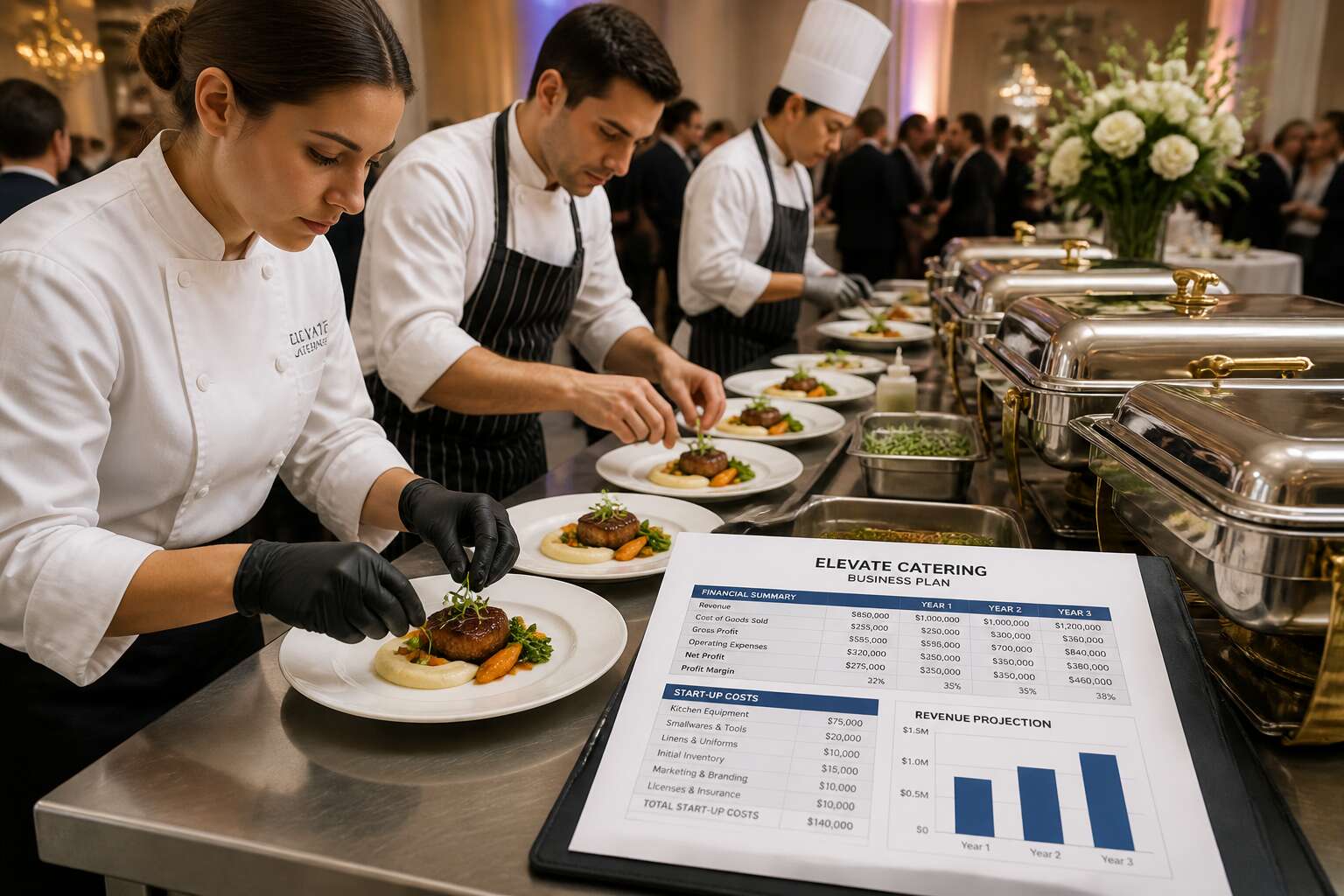
Foundational Elements for a Successful Catering Venture
Defining Your Catering Niche and Service Style
A catering operation begins with a decision about who it feeds and how. In South Africa, where weddings, corporate launches, and township festivals each demand distinct approaches, the founders who survive are the ones who make an early choice. The strongest catering business plan examples devote their opening pages to this exact decision.
Service style matters just as much as the menu. Will you run a buffet, a plated dinner, or a grazing table? Each style changes your staffing, your equipment, and your pricing model:
- Buffets suit large groups and reduce labour costs.
- Plated service elevates the occasion but requires more waitstaff.
- Grazing tables encourage mingling and work well for cocktail events.
That choice shapes everything! In my own work, I have seen clarity here prevent costly missteps later. Reviewing catering business plan examples from established firms, you will notice the same pattern: a defined niche, a consistent service style, and no confusion about either.
Drafting a Compelling Mission Statement
Most caterers can describe a menu in detail but freeze when asked why they cook. A mission statement answers that question for them. The strongest catering business plan examples treat this phrasing with genuine care. It is not decoration. It is the working document that shapes every quote, every supplier call, and every menu decision.
A promising mission statement avoids vagueness. It names the customer, the emotion, and the food. A caterer for Cape Town corporate events might promise punctual elegance. A township caterer might pledge generosity and abundance. Both are clear. Both guide the proprietor when a client demands a menu that contradicts the business’s raison d’être.
Here are elements that define a strong mission:
- Using active verbs that convey energy
- Confining the statement to a single breath when spoken
- Including a measurable standard, such as freshness or punctuality
Setting Short-Term and Long-Term Business Goals
I know the terror of a prep list with too many crosses. Goals should not replicate that chaos. Foundational elements in catering business plan examples separate the achievable from the aspirational.
Short-term goals, those within the first year, might include securing three recurring corporate clients or cutting supplier invoices to once a fortnight. The best catering business plan examples treat these early wins as proof of concept, not as the finish line. Long-term goals demand harder arithmetic. A second kitchen, a transport fleet, or a booking pipeline that survives a Cape Town winter without a drip of panic.
Consider these elements when setting goals:
- Cash flow visibility for the next twelve weeks.
- Staff training that turns minimum wage into minimum chaos.
- A menu cost matrix that accounts for loadshedding losses.
Without these, the plan is merely a document. With them, it is a schedule worth following.
Choosing the Right Legal Structure for Your Food Service Company
Legal structure determines how your personal assets and business liabilities stay separate. A sole proprietorship leaves your home exposed. A private company, or PTY Ltd, offers protection yet demands annual CIPC filings and stricter accounting discipline. I have seen too many caterers choose based on what a friend recommended. Follow your growth trajectory instead, and do not take the easier path this month!
Catering business plan examples often reduce this to a formality. That is a mistake. Your structure affects every supplier contract, every hire, and every insurance premium. Consider these foundational elements:
- Personal liability exposure for food safety claims or cancelled events
- VAT registration once monthly turnover approaches R1 million
- Director duties under the Companies Act for PAYE and UIF
Each catering business plan example reflects a different answer because the correct structure follows the scale of your operations. A weekend caterer can survive as a sole proprietor. A business serving corporates in Sandton cannot. Weigh the administrative burden against the risk and register the entity that protects your future.
Conducting a Thorough Market Analysis for Your Local Food Business
Identifying Your Target Audience and Client Segments
The most profound mistake a prospective caterer can make is to assume the market is a monolith. In South Africa, the culinary landscape is a mosaic of cultural traditions, economic realities, and regional palates, each with its own distinct demands. A thorough market analysis is not a mere formality; it is the lens through which you will perceive genuine opportunity. Examine the competitive density in your chosen radius, the average spend per head at corporate functions versus private celebrations, and the prevailing dietary trends that are gaining legislative and consumer traction. Weigh these factors against your own operational capacity to identify a sustainable position in the ecosystem.
Identifying your target audience and client segments requires a similar level of introspection. Your catering business plan examples should not list generic categories like “weddings” or “corporate events.” Instead, define the psychographic profile of your ideal client. Consider their values, their decision-making triggers, and the specific anxieties they have about their event. This distinction shapes your service offering. To refine your focus, you might list key variables that influence your strategy:
– The primary occasion types that generate 80% of your projected revenue.
– The average booking lead time in your target market segment.
– The preferred communication channels for your prospective clients.
– The acceptable price tolerance relative to perceived value.
This granular approach ensures that your planning is not a theoretical exercise. It becomes a practical tool for resource allocation, from menu engineering to staffing schedules)Skip the history lesson. We are concerned with the immediate future standard. The consequence is a realistic financial projection and a service that feels essential to a specific group of people.
Analyzing Competitors and Regional Saturation
Before you fall in love with your own canapés, glance sideways at what your neighbours are serving. Regional saturation erodes revenue quietly. Walk the chosen suburb and count the food trucks, the weekend pop-ups, the aunties running hire-a-caterer operations from their home kitchens. Each one is a data point. Study their menus, price lists, and social media engagement. This intelligence grounds your strategic thinking in observable reality.
Observe the competitive density across the week. A Friday lunch market may be saturated while Tuesday corporate functions remain wide open. Consider average spend per head. Are clients paying for grazing tables or efficient buffet service? For a sharper view, list the following:
– The three competitors closest to your proposed operating radius.
– The gap between their prices and their service quality.
– The reviews that mention delays, bland food, or poor staff.
– The dietary offerings they ignore altogether.
The answers reveal whether you compete on price, polish, or sheer convenience. Write your catering business plan examples around that local reality, not a romanticised ideal of the industry.
Understanding Current Trends in the Events and Hospitality Sectors
Johannesburg’s events calendar told a different story than your spreadsheets might suggest. Conferences shrank while private fine dining pop-ups surged. The hospitality sector rewards caterers who pivot quickly, not defenders of a single format.
Market analysis for a local food business requires reading the current appetite. Track what event planners request: halaal certification, plastic free service, carbon neutral sourcing. These factors shape menus and budgets more than any quarter end forecast, trust me, I have seen it!
Trends worth capturing in your catering business plan examples:
- The rise of grazing tables over plated service in Gauteng corporate bookings.
- The expectation of interactive food stations, from sushi hand rolls to live braai counters.
- The fall of fixed seasonal menus in favour of chef’s choice, subject to local produce.
Recent hospitality data shows a jump in enquiries for sustainable menu options. Caterers who adjust to these signals are securing next year’s contracts.
Evaluating Market Opportunities and Potential Threats
Load shedding teaches caterers more about their local market than any spreadsheet. The moment cold storage fails at a venue, you learn who controls backup power, which suppliers can deliver at short notice, and what clients actually value. These disruptions reveal opportunities and risks that calm spreadsheets miss. Proper market analysis tracks them alongside municipal health inspection rhythms, seasonal produce gluts, and the cost of staff transport to event sites.
Catering business plan examples that secure investor attention usually quantify these local variables. They include clear threat assessments:
- Which venues lack reliable cold storage during outages?
- How do fuel price hikes shift your delivery radius?
- What happens to your menu costs when a staple crop floods?
Answers to these questions shape realistic pricing and scheduling. Catering business plan examples that ignore these local realities become elaborate wish lists.
Establishing Key Performance Benchmarks for the First Year
Thorough market analysis for your local food business is not an afternoon of scrolling through competitor pages. It is a continuous practice of counting empty chairs at weekend markets, checking which neighbourhoods are opening office parks, and asking your dry goods supplier about price shifts before they appear on invoices. Catering business plan examples that impress lenders include these specifics in the appendix.
Performance benchmarks for the first year should come from your service area. Track a short list of numbers that matter:
- Cost per guest served
- Quote conversion rate per price tier
- Repeat booking rate
These measurements show where your margins hold and where they fail. Catering business plan examples that set benchmarks against national averages instead of local data will mislead you. A caterer in Durban and one in Polokwane share the same job title, but in my experience, never the same costs.
Structuring Your Operations Plan and Event Logistics
Outlining Daily Workflows and Kitchen Management
Between the glamour of tasting menus and the terror of a bridezilla demanding a vegan gluten free cake at 9 PM, lies the real beast of the catering industry. It is not the food. It is the logistics. A business plan can look gorgeous on paper, but if your kitchen workflow resembles a mosh pit, your profit margin will evaporate faster than a chafing dish on a Durban summer afternoon. The successful operators know that a catered event is simply a factory that happens to have tablecloths.
To avoid a catastrophic cluster, you need to dissect the operational anatomy of your service day. This involves mapping the journey from the receiving dock to the buffet line. You must determine when the prep team starts, when the ovens reach peak temperature, and how you will plate 200 portions of bobotie without losing your mind. A solid plan outlines the line of command, specifically who has the authority to yell at the supplier when the lamb arrives late.
Operational clarity prevents chaos, but it also requires a specific sequence. Consider the critical path for a standard Saturday function:
– Final walkthrough and venue access at 08:00.
– Equipment and dry goods offloading by 08:45.
– Hot food production commences at 10:00.
– Plating and garnishing starts at 16:30.
– Service window opens at 18:00.
The kitchen is the beating heart of the operation, but it is also the most likely place for a cardiac arrest. You need to define stations, assign roles, and implement a system for stock rotation that does not rely on hope. This is where the concept of “mise en place” moves from a culinary school slogan to a survival tactic. If your staff are searching for a whisk during the dinner rush, you have failed the logistics test.
Furthermore, the workflow must address the clean-up phase, which is often the most underestimated segment. Many catering business plan examples fail to allocate sufficient labor hours for the breakdown and sanitation. You must decide whether you are hauling dirty dishes back to the central kitchen or hiring a third party for on-site washing. This decision impacts your vehicle load capacity and your water usage. The logistics of waste disposal, especially in locations with strict municipal bylaws, needs to be written into the operational plan.
Ultimately, the supply chain is the quiet hero of the event. If you rely on a single bakery for bread rolls and their oven breaks, you need a backup strategy. The smart operator builds a buffer for essential commodities, but also builds relationships with secondary vendors. By outlining these contingencies in your plan, you transition from a dreamer to a manager. The resulting document should read like a technical manual for a well oiled machine, not a wish list. That level of detail is what separates the professional outfits from the glorified braai masters.
Managing Suppliers and Vendor Relationships
Operational structure means little if the suppliers fail you at the gate. In catering business plan examples, vendor relationships are often an afterthought, yet a single missed delivery can collapse an entire function. I have seen contracts signed without delivery windows or penalty clauses. That is a mistake.
Your operations plan must name every supplier, their contact line, and their backup. Do not rely on a single butcher when the power fails. Build a table of ordering deadlines, load sizes, and cold chain responsibilities.
- Confirm delivery times against the event critical path.
- Define who inspects produce and rejects substandard goods.
- Set payment terms that protect both parties.
By embedding these details into your catering business plan examples, the plan becomes a working ledger, not a philosophy!
Planning Equipment, Venue, and Transportation Needs
Structuring your operations plan starts with the venue itself. The site dictates what equipment you bring, what you leave behind, and how your team moves. A vineyard estate outside Stellenbosch has different power access than a city loft in Johannesburg. Your catering business plan examples must record these variables for every recurring function.
Transportation needs deserve the same attention as the menu. Cooked food loses quality in traffic. I have seen caterers lose an entire main course to a late departure and poor insulation. Map the route, check load sizes, and assign one person to vehicle readiness. A simple equipment list helps:
- Portable hot boxes and cold carry cases
- Service utensils and backup cutlery
- Extension cords and heavy duty tape
- Cleaning supplies for post function breakdown
Venue contracts often hide loading dock time limits or generator fuel costs. Read those clauses twice. When your catering business plan examples include a logistics checklist for each site, you turn chaos into a repeatable process.
Developing a Memorable Marketing and Sales Strategy
Implementing Digital Marketing Tactics for Local Reach
In the competitive South African events landscape, word of mouth alone is no longer a sufficient growth engine. Your marketing strategy must translate your culinary identity into a compelling narrative that resonates with event planners and corporate clients. This is where the theory in your catering business plan examples transforms into tangible bookings. The goal is to create a brand presence that feels indispensable before a client even tastes your food.
Building that presence requires a deliberate focus on local digital ecosystems. A robust Google Business Profile is non-negotiable for appearing in local searches, and your Instagram feed should showcase the texture of your dishes and the atmosphere of your events. I have seen catering companies double their inquiries simply by posting consistent, high-quality content from real functions.
To ensure your strategy has depth, consider these tactical elements for your digital outreach:
- Implement geotargeted ads on social media platforms to reach users in your specific city or suburb.
- Collaborate with local wedding planners and event venues to cross-promote services.
- Encourage clients to leave reviews on Google and Facebook to build social proof.
- Optimise your website for mobile browsing to capture on-the-go research.
Beyond the basics, your sales process should be as polished as your plating. When you respond to a lead, move swiftly. Provide a clear, itemised quotation that reflects the professionalism of your operation. This responsiveness signals reliability, a trait that is highly prized in the hospitality sector.
A successful digital strategy also involves nurturing past clients. A simple seasonal email to a corporate client reminding them of your menu for the upcoming holiday party can secure repeat business. This direct approach is often more effective than broad advertising campaigns. By aligning your digital footprint with a personalised sales follow-up, you create a revenue pipeline that supports the financial projections in your catering business plan examples.
Networking with Event Planners and Wedding Venues
One referral from a trusted wedding planner carries more weight than a hundred Instagram ads. I have seen this play out across Johannesburg and Cape Town catering scenes. Your catering business plan examples should account for the time it takes to build these relationships. They do not form overnight.
Networking with event planners requires a specific approach:
- Show up at their venue openings and site inspections
- Taste their preferred suppliers’ products before pitching
- Know their client profiles and event styles
When a planner trusts your food, they sell it before you walk into the room. Wedding venues operate the same way. A venue coordinator who has eaten your canapés at a tasting event will recommend you without hesitation. These connections drive your bookings.
Creating a Simple Sales Funnel for Private Bookings
Marketing does not need a viral moment. It needs a single promise repeated until clients repeat it back to you. Your catering business plan examples should show how that promise flows through a sales funnel, not just a mood board.
A simple funnel works like this:
- Awareness: one signature dish photo posted weekly
- Consideration: a tasting menu guide exchanged for an email
- Booking: a 20 minute consultation call with a clear proposal
Each stage filters out someone who does not belong at your table. The photo attracts. The guide qualifies. The call closes. Most caterers treat all three stages as one conversation and then wonder why their leads disappear. A proper funnel gives every lead a next step, even the ones not ready to book this month.
Leveraging Customer Reviews and Testimonials
The quietest marketing tool is the returned compliment. In South Africa, trust moves through braai smoke and WhatsApp forwards, and a testimonial carries the weight of an actual handshake. For any catering business plan examples, the review section becomes the living appendix, the place where your promises meet their proof.
Gather words from the bride who wept at the dessert table and the corporate planner whose deadline you quietly saved. Ask for feedback within 48 hours of the event, reply to each note with a specific detail, and place the one that mentions your signature dish directly beneath your contact form. Do not over-polish them. Imperfection reads true.
- Request reviews via a short, warm SMS link after delivery
- Pair a quote with the photograph of that exact table setting
- Refresh the featured review every season to reflect current menus
Weave these voices into your sales conversations, letting a past client finish the pitch for you. The stranger who reads your site wants evidence, not assurance. A single specific sentence from a former host can steady their decision more than any glossy brochure ever will.
Retaining Clients Through Loyalty and Referral Programs
In catering business plan examples that truly work, marketing is not separable from cooking. It is the way you answer the phone at 6am, the way you remember a client’s dislike for coriander, the way your driver greets the gate guard at a Durban estate. A client who feels remembered will ask for your quote first.
Loyalty lives in small courtesies. A complementary dessert for a returning corporate client. A handwritten menu card for a family booking their third birthday party.
- Hold a 10% rate for clients who book twice in a year
- Give a referral bonus that rewards both the client and the newcomer
- Share a seasonal tasting menu with past clients first
When past clients feel like part of your team, marketing stops being a pitch and becomes an invitation. Catering business plan examples with strong loyalty programs survive quiet months with reputations intact.
Forecasting Financials and Managing Cash Flow
Estimating Startup Costs, Licenses, and Permits
Forecasting financials for catering business plan examples requires more than just a spreadsheet. It demands a clear-eyed view of the costs that often hide behind the glamour of a gleaming prep counter. Startup expenses can include a commercial kitchen deposit, specialized catering vans, and branded chafing dishes. In South Africa, you also must budget for municipal health certifications and liquor licenses if you plan to serve beverages. A numbered list of key financial inputs helps establish this baseline:
1. Equipment purchases and leasehold improvements
2. Initial inventory and food safety supplies
3. Uniforms, insurance premiums, and registration fees
Cash flow becomes the quiet engine that keeps your operation alive. A large wedding event, for instance, may require weeks of advance spend on ingredients and staff. This means your forecast should track monthly revenue against the rhythm of pending payments. Mismanaged timing creates a gap where invoices arrive before client deposits come through. Many robust caterers survive lean seasons by building a reserve from peak months. Accurate projections also help you approach banks with realistic loan requests. The true value of studying catering business plan examples lies in seeing how others measured these cycles, not just in copying their menus.
Adopting a Food Costing and Pricing Model
Forecasting financials and managing cash flow sits apart from the optimism of projected revenue. A single catered wedding in the Cape Winelands can tie up funds for weeks before the first deposit lands. Reviewing catering business plan examples shows how operators track monthly income against supplier terms, rental deadlines, and seasonal troughs. Your forecast should reflect this lag, with a buffer for quiet months. Supplier invoices rarely wait for event day, and petty cash disappears quickly when cold storage fails.
Adopting a food costing and pricing model requires accurate portion data. Calculate the raw ingredient value of each plate, then layer in fuel, labour, and packaging. Many South African caterers target a 30% food cost margin, but the real figure depends on your menu and supplier contracts. When you study catering business plan examples, notice how they negotiate volume discounts and adjust for seasonal substitutions. A price list from last summer may not survive this year’s load-shedding impact on cold chains.
- Track accounts payable weekly
- Separate client deposits from operating funds
- Review menu pricing every quarter
The numbers only speak when you check them often. A forecast that ignores payment cycles becomes a guess, and a pricing model without portion control leaks profit quietly. Build these habits early, and the business stays steady when the event calendar thins.
Creating a Monthly Budget and Cash Flow Projection
The quiet arithmetic behind a successful catering company rarely appears on the menu. Cash flow, not cuisine, often determines whether a business survives its first winter. Catering business plan examples reveal a common truth: the festive season deposits arrive in August, but the expenses for those events hit the account months later. This lag creates a financial rhythm that demands respect.
Building a monthly budget requires a clear eye on the overlap between client payment schedules and your own operational deadlines. Revenue projections must account for the gap between booking deposits and final settlements. Many operators find that while the event calendar looks full, the bank account tells a different story. The forecast should therefore reflect both the confirmed work and the slow months that inevitably follow.
– Review supplier payment terms and align them with your own client invoicing cycles
– Identify fixed costs that remain constant regardless of event volume
– Separate VAT obligations from operational spending in your monthly projections
A cash flow projection becomes a living document when checked against actual spending. The beauty of a well maintained forecast lies in its honesty. It shows when the business can afford new equipment and when it must hold back. Catering business plan examples often highlight this discipline as the dividing line between a venture that thrives and one that merely survives.
Determining the Break-Even Point for Your Events
Forecasting financials without a break-even figure leaves every event a gamble. Each function has a specific point where revenue covers all costs. Catering business plan examples show how operators define this point per event type, not just for the whole year.
Take a corporate lunch for 50 people. Add food, labour, equipment hire, and delivery. Divide the sum by the expected guest count. The result is your minimum price per plate. Compare that with your quote.
- Include all variable costs for the specific event
- Add a share of fixed overheads
- Check the figure against your actual menu pricing
Reviewing this number after every menu change protects your cash flow. I have watched too many caterers skip this step. Some business plans miss this practice entirely. Yet the break-even point is the quiet guardian of every profitable event.
Building Your Organizational Team and Long-Term Support Plan
Defining Key Staff Roles and Hiring Priorities
Your signature dish can be flawless, but if your staff crumbles under service pressure, the entire experience sours. This is where many catering business plan examples fail to offer depth, treating the team as an operational afterthought. The cold truth is that your people are the ones who execute your culinary vision when the lights are low and the champagne flutes are full.
The first senior hire should be a head chef who understands volume without sacrificing finesse, followed closely by an operations manager who lives for logistics. Your front-of-house lead needs to be a diplomat, reading a room’s energy before the starter is plated. Prioritise a small, versatile core team who can switch between grilling and greeting without missing a step.
A sustainable structure revolves around cultivating a reliable bench of casual staff rather than relying on frantic last-minute calls. You need a system for ongoing training, not just a laminated checklist. Your long-term support plan should address career progression for core staff and a clear protocol for evaluating temporary hires after each event.
– Line cooks who can improvise within a strict framework.
– A service manager skilled in pacing and client communication.
– Logistics staff who handle load-in and load-out with zero drama.
Developing this backbone takes time, yet it is the very thing that separates a reputable caterer from a fleeting venture. By prioritising your people, you operationalise a standard of excellence that becomes visible to every client you serve. The result is a lean, durable structure that forms the true heart of your catering business plan examples.
Outlines for Employee Training and Safety Procedures
Most catering operations falter not on the quality of the food, but on the friction of a disorganised crew. A clear organisational structure is the blueprint for service excellence. Your staffing plan should outline a hierarchy that defines every role, from the executive chef to the event captain, ensuring everyone knows their specific duties before the first plate is sent out. This clarity is a cornerstone of credible catering business plan examples.
The long term support plan requires a system for employee training that goes beyond a single orientation. Regular workshops on food safety standards and client interaction should be scheduled throughout the year, with a specific focus on crisis management. Safety procedures, including fire prevention and allergen handling, must be reviewed at every staff briefing to keep protocols sharp and top of mind.
– Practical knife handling and equipment operation for junior chefs.
– Proper lifting techniques to prevent injuries during load in and load out.
– Clear procedures for managing cancellations or sudden weather changes during outdoor events.
Your safety manual should read like a practical field guide specific to your venues. Include a strict protocol for temperature logs and a communication tree for emergencies that staff can follow without hesitation. In South Africa, where load shedding can interrupt service, your plan must include backup equipment checks and a power outage playbook. By formalising these processes, you create a resilient business model that traders and investors will respect. Ultimately, the best catering business plan examples treat employee support as a core strategy, not an administrative footnote.
Identifying Trusted Advisors, Suppliers, and Insurance Partners
Building your organizational team extends beyond payroll. You need trusted advisors who understand your operational reality. A good accountant, a hospitality lawyer, and an insurance broker form the core. For South African caterers, these relationships matter even more because load shedding and water restrictions add complexity. Your supplier network is equally important. Consider these support partners:
- A primary fresh produce vendor with backup supply options
- An equipment rental company for emergency oven or fridge replacements
- An insurer who covers event cancellation and public liability
In credible catering business plan examples, these names appear with contact details and response times. That specificity shows investors you have mapped your risks. I always include a quarterly review schedule for these partnerships. That simple practice keeps your support system sharp.
Creating a Roadmap for Scaling Your Event Business
Scaling an event business demands more than the right equipment or a brimming client roster. The organizational team itself must evolve into a cohesive unit with clear reporting lines. In credible catering business plan examples, the growth roadmap hinges on documented processes and delegated authority.
I treat long-term support as a layered structure. Every chef, coordinator, and driver should understand the responsibilities one step above their own. Cross-training prevents workflow stoppages when demand spikes. Durable catering business plan examples show specific benchmarks for this training.
- Define shift captains for every function.
- Schedule quarterly skill audits.
- Create a written succession plan for key roles.
This roadmap transforms your operation into a resilient pipeline ready for the next booking surge.




0 Comments